
Important: This website is intended for readers in Denmark and the EEA and offers general education about everyday movement habits only. It is not medical, physiotherapy, or chiropractic care; it does not diagnose, treat, or prevent disease, and it does not promise specific results. Information is presented in line with Danish and EU expectations for honest, non-misleading communication (including the Danish Marketing Practices Act, markedsføringsloven, and unfair commercial practices rules). If you arrive from an online ad (for example Google Ads), the landing page matches the ad: editorial education, transparent business identity, and no remote clinical service. Stop any activity that feels unsafe and consult an authorised health professional for personal advice. Terms of Use · Privacy Policy · Cookie Policy.

Odense, Denmark · English pages

Short movement breaks for desk-heavy days

Editorial ideas for people in Denmark who want simple, low-intensity movement between tasks—not a treatment plan and not a substitute for professional care. Pick one or two breaks when it suits you; skip anything that does not fit your day.

60–90 seconds No equipment Indoors friendly

Request the free cue sheet (PDF)

Optional mailing list for printable reminders only—no fees, no products sold on this page. Any marketing beyond the requested PDF would require a separate opt-in under Danish rules. You can unsubscribe or request deletion anytime (GDPR); see our Privacy Policy.

Request the cue sheet

Why tiny moves matter

Your posture is a conversation, not a pose

Think of posture as the way you distribute weight while you read a message, reach for tea, or lean into a call. Long stretches of stillness are common in modern work; many people like brief changes in position—ankles shifting, shoulder blades sliding, eyes changing focus. The drills here are short, optional patterns for variety, not instructions tailored to any medical condition.

Every article is written in plain English: where to place your feet, how slowly to move, what you might notice in your shirt seams. We describe mechanics and subjective sensations so you can judge what feels appropriate. We do not claim that any sequence will improve a health condition or replace assessment by a licensed clinician.

If you live in Denmark, you already navigate crisp bike commutes, hygge corners, and long winter evenings indoors. These routines borrow from that lived texture: short outdoor breathers when possible, warm-light interiors when not, and respect for personal boundaries around health data—mirrored in our GDPR-minded forms and cookie tools.

When in doubt, slow down the tempo. Quality of attention beats counting repetitions.

Health & Safety Guidelines

Move like you are curious, not like you are proving something

These guidelines keep the experience respectful of different bodies and energy levels. They are not a substitute for individualized guidance from a qualified clinician when you need it.

Before you begin

Pick footwear or socks with reliable grip if you stand on hardwood. Clear a half-meter bubble around your chair so elbows and knees do not meet furniture edges. If you are under care for an injury or a health condition, use these pages as optional reading only—not a personalised programme.

  • Sipping water during long sessions is ordinary self-care; it is not presented here as a medical intervention.
  • A comfortably warm room on damp Danish days can make movement practice more pleasant for many people.

During practice

If anything feels strongly uncomfortable, stop and return to a neutral seated or standing position. These pages are not for pushing through pain. Breathe through the nose when that feels easy; exhale gently—soft, long, unforced.

  • Let your gaze lift to a distant window sill every few moves to vary focal distance.
  • Set a gentle timer so you are not watching the clock with tension.

Pregnancy, bone-health questions, balance concerns, or use of mobility aids are examples of topics where an in-person professional should guide you. We cannot see your home layout or workspace; editorial text is not a risk assessment.

Three moves to bookmark

Seated rib glide, wall snow angel, silent heel lift

Each block below is a miniature workshop. Read once, then try with the timer on your kettle or phone—no soundtrack required.

Seated rib glide

Sit toward the front third of the chair. Feet flat, knees roughly over ankles. Place fingertips lightly on the lowest ribs at the sides. Inhale so the ribs expand laterally into your fingers; exhale and let the ribs soften inward without collapsing the chest forward. Repeat six cycles, moving slowly enough to feel the seam of your shirt shift. This invites the thorax to participate instead of freezing in a lifted brace.

Educational note (subjective): Some readers notice less habitual neck bracing when ribs move freely; others do not. This is coordination practice for interest only, not a prescribed exercise for a medical symptom.
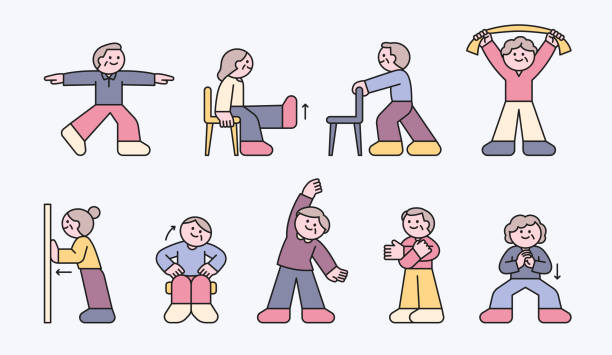
Wall snow angel lite

Stand with your back against a smooth wall, heels a hand width away. Softly tuck the pelvis so the lower back is neither arched nor pressed hard. Glide the backs of the hands up the wall in a narrow V, only as far as shoulders stay easy. Lower with control. Perform eight reps, resting between if the wall feels cool on your skin.

Educational note (subjective): The arms explore upward range without weights. It is a movement experiment after desk work, not a claim to treat shoulder conditions.

Silent heel lifts

Stand tall holding a countertop lightly for balance. Lift both heels two centimeters, lower with a whisper-quiet landing—imagine you are in a library of vintage books. Repeat twelve times. Keep the ankles aligned; avoid rolling outward. Finish with ten slow calf breaths walking in place.

Educational note (subjective): Gentle heel lifts change how load passes through the feet after sitting. They are not described as therapy for circulation or any disease.

Events Calendar

Illustrative gatherings (confirm by email)

The table below is illustrative only—a planning sketch, not a contract to deliver services. Dates and formats can change. Always email hello@natureibeaut.world before making travel plans.

Date Format Focus
18 May 2026 Outdoor walk-shop Carrying a light pack with level shoulders
4 June 2026 Studio-style demo Wall line drills without pushing range
22 June 2026 Online Q&A Questions about daytime pacing, not diagnoses
10 July 2026 Neighborhood stroll Mapping micro-stops along a 3 km loop

Events emphasize education and shared practice. They are not marketed as replacements for clinical services, and participation is voluntary.

FAQs

Plain answers about pacing, clothing, and email

Many readers tell us they like a small set of moves mid-morning, another after lunch, and a lighter sequence before commuting home. If that feels like a lot, start with one short break on days you remember. Nothing here is a prescribed medical dose.

Wear anything that lets you lift an arm overhead without resistance. Vintage-inspired wool layers work well in Danish spring; just avoid skirts that restrict stepping sideways if you try the wider stance drills on other pages.

We route it through our small studio inbox for the cue sheet only. You may request deletion under GDPR; details live in the Privacy Policy.

Young people often enjoy heel lifts and wall taps. Supervise playfully, keep durations short, and avoid turning it into a performance review. Parents remain the best judges of readiness.

Evidence, softly told

What workplace studies usually whisper—not shout

Some occupational-health studies ask office workers about breaks lasting only a few minutes. Results differ by workplace and questionnaire design; a common self-reported pattern is that people who vary posture occasionally describe different comfort than those who sit still all day. That is survey language, not proof of medical benefit and not a reason to delay seeing a clinician if you need one.

Eye-care guidance from public-health bodies often recommends varying viewing distance during screen work. We mention it as general ergonomics literacy, not optometry advice. We summarise trends from the literature without promising outcomes for you personally.

  • Look for systematic reviews on workplace movement prompts if you want primary literature.
  • Discuss surprising discomfort with a qualified professional rather than forums alone.
Neutral standing alignment reference photo

Visual anchor

Let the frame remind you: space is symmetrical

Prints and posters once taught posture through elegant silhouettes. We revived that spirit in a digital line drawing you can glance at between tasks. Alignment here means equal attention left and right, not yanking yourself taller.

Try this while viewing the art: stand with weight shared between feet, soften the jaw, and imagine a gentle string from the crown toward the ceiling while the sit bones still have downward access. Hold the thought for three slow breaths, then release. Repeat whenever you pass this section scrolling on your phone—mobile layouts keep the frame legible down to 320px width.

Choose your doorway

Keep exploring without pressure

Pick the page that matches today’s furniture: desk, doorway, breath, or calendar mindset. Each route ends with the same reminder—information here is general, kind, and non-clinical.

Layered plans

Combine desk micro-moves with a weekend rhythm page when you want a narrative arc for the month ahead.

Open weekly rhythm

Policies & care

Privacy, cookies, and terms are written for EU readers, including Denmark’s alignment with GDPR expectations.

Read privacy policy